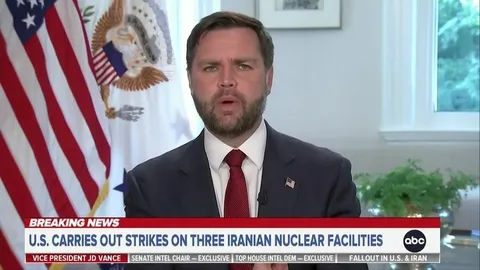
US Vice President JD Vance has said Iran must make a “meaningful” cut in its nuclear enrichment capacity before Washington agrees to end the seven-month war. He made the comments in an exclusive interview with Reuters, according to reports on Tuesday and Wednesday. Vance said any deal would need real action on Iran’s nuclear program, not promises of future cuts. The Iran US war has shaken energy markets and become a political issue ahead of the November midterm elections.
Background: The Iran US War and the Nuclear Dispute
The war began about seven months ago, and Reuters reports that joint US-Israeli strikes at the start killed Iran’s Supreme Leader Ayatollah Ali Khamenei. Since then, the conflict has disrupted shipping through the Strait of Hormuz, a vital route for global energy supplies. Reuters says the war costs about $3 billion a month, and it has jolted global markets.
Diplomacy has been tried several times. Axios reported in April that Vance would lead the US delegation at peace talks with Iran in Islamabad, hosted by Pakistan. A provisional peace deal brokered by Vance in June fell apart quickly, according to Business Standard’s summary of the Reuters report.
At the heart of the dispute is the Iran nuclear program. Washington has long demanded limits on enrichment, while Tehran says its program is for civilian use. Axios quoted one analyst as saying the minimum US requirements include removing 60 per cent enriched uranium and suspending enrichment for as many years as possible.
Details: What Vance Told Reuters
Vance spoke to Reuters on Monday in Fairbanks, Alaska, after a campaign trip. He said Iran must reduce its enrichment capacity to meet US demands, and that offering assurances of future cuts would not be enough. Reuters reports that he described this as a “very basic threshold issue.”
He also questioned why Iran would need 60 per cent enriched fuel if it did not want a nuclear weapon, according to ANI. In his view, a country committed to avoiding a weapon would act on its enrichment capacity in a meaningful way. These points repeat long-standing US arguments.
Iran and the US have exchanged proposals in recent weeks to end the war and reopen the Strait of Hormuz. ANI reported that President Donald Trump dismissed Iran’s most recent offer and warned that US military action could escalate after the November midterms. Vance also said he had spoken with field commanders and rejected suggestions of critical munitions shortages.
Who Speaks for Tehran?
Vance said Washington is unsure how decisions are made in Tehran. The US is talking with Iranian President Masoud Pezeshkian and Foreign Minister Abbas Araqchi, but Vance said it is unclear how much authority they have within Iran’s power structure. That uncertainty follows the death of Khamenei in the opening strikes.
This is a key obstacle for negotiators. A deal requires both sides to trust that the other can deliver. Without clarity on who decides, progress can stall.
Quotes: What Officials Have Said
“We’re not going to trade words for actions,” Vance told Reuters, according to several outlets. He stressed that the US remains open to a deal but wants measurable steps. That line captures the US position.
Iran’s government has rejected demands it sees as denying its right to enrich uranium. Axios quoted Iranian parliament speaker Mohammad Bagher Ghalibaf in April as objecting to a statement from Trump that denied Iran’s right to enrichment. Iran’s current response to Vance’s latest comments was not available in the reports reviewed.
Impact: Why This Matters
For the war, the demand shows that the nuclear issue remains the main sticking point. The US wants a clear reduction in capacity, while Iran has resisted limits it sees as a loss of sovereignty. Until one side moves, a lasting ceasefire looks difficult.
For the global economy, the Strait of Hormuz is the most immediate concern. Any prolonged closure or disruption can push up oil prices and affect fuel costs worldwide. Vance spent much of his Alaska speech on energy affordability, which shows how directly the war touches voters.
For US politics, the war is a liability for Trump and Republicans ahead of the midterms, according to Reuters. Vance is seen as a leading Republican contender to succeed Trump, so his handling of the talks carries personal political weight. For Pakistan and the wider region, the conflict raises security and economic risks, and Islamabad’s role as a host of talks has been noticed.
Conclusion: What Comes Next
More exchanges of proposals are expected, though no new round of formal talks has been announced in the reports reviewed. Trump has hinted at escalation after the midterms, which gives both sides a rough timeline. The next step may depend on whether Iran offers a concrete cut in enrichment capacity.
Whether the two sides can bridge the gap is unclear. Verification by the International Atomic Energy Agency would likely be part of any deal. For now, the Iran nuclear enrichment issue remains the key test of whether the war can end through diplomacy.
Frequently Asked Questions (FAQs)
Did Iran actually have 60% enriched uranium?
Yes. The International Atomic Energy Agency (IAEA) reported before the current war that Iran had built up a stockpile of uranium enriched to 60 per cent, well above the 3.67 per cent limit set in the 2015 nuclear deal. By mid-2025, the agency estimated the stockpile at several hundred kilograms. Sixty per cent is not weapons-grade, which is around 90 per cent, but it is a short technical step from it, which is why Western governments are alarmed. Iran says its program is peaceful. Since the war began, the exact status and location of the material has been disputed, so check the latest IAEA statements.
Did Vance support the war in Iran?
Vance has publicly defended President Trump’s Iran policy. In June 2025, he said Trump might decide to take further action to end Iranian enrichment, while acknowledging concerns about foreign entanglement. Reuters describes him as a longtime skeptic of US involvement in foreign wars, who has taken a leading role in negotiating a settlement. He led the US delegation at talks in Islamabad in April and brokered a provisional deal in June that later collapsed. His private views are not public, so the safest summary is that he has backed the administration’s goals while pushing for a diplomatic solution.
When did Iran achieve 60% enrichment?
Iran announced that it had begun enriching uranium to 60 per cent in April 2021, at the Natanz facility. The announcement came after an attack on Natanz that Iran blamed on Israel, which Israel did not formally confirm. At that time, the move was widely seen as a response to the sabotage and as leverage in negotiations to revive the 2015 deal. Iran later expanded its 60 per cent production, and the stockpile grew in the following years. Its enrichment work has been a central issue in every round of talks since.
Who are the players in the Pakistan national T20 cup squad for 2026?
I could not confirm a specific squad called the “national T20 Cup squad for 2026.” The National T20 Cup is a domestic tournament with regional teams, and its squads are named by the PCB and regional associations. If you mean the Pakistan national team, the latest T20I squad for the Sri Lanka series is led by Sahibzada Farhan, and the full list was announced on Monday. For domestic team lists, check the PCB’s official website.